Friday, January 17, 2014

From the Home-front to Home

Dear father and mother,
        The war is stressful. The Germans are unrelenting in their assaults on our great land of France, and they gain more land everyday. However, we French are not to be trifled with, for we are giving them a hard time of it; countless Germans have fallen in their reckless charges. I have personally seen hundreds die, but the airplane scouts report fields littered with corpses, easily numbering in the tens of thousands. I would laugh in the face of the Germans and their commanders for using such outdated strategies, but our own commanders are equally foolish and mirror the Krauts' tactics.
         Every day is the same, but different. Pitiful areas of land are gained and lost, and still people die. Both sides sit in their trenches, waiting for the other to make a move... the Germans usually go first. They charge with their bayonets and attempt to throw grenades into our trenches, but they are mostly gunned down by our artillery and rifles. Yet, some make it through, and woe is the soldier who's trench has a poison canister lobbed into it; a grenade can take several seconds to explode, giving us time to throw it back, take cover, or run away...but a gas canister usually begins to extrude its poison death while in midair, so that gas instantly covers the area it lands. We have gas masks, but not all of us are quick. Jean Luc, from our village, got his mask tangled up in his backpack while panicking and...he did not make it. It appeared a most painful death, as he coughed and coughed as though he was permanently choking. Please, lie to his parents and tell them that he died in a valiant effort to save his fellow comrades, and that we owe our lives to him; no one should have to know that their son died painfully due to bad luck.
         I find myself numbing. I have seen countless comrades and enemies die, but they feel the same to me. One death is just one more soul lost in this hell of explosions, gunshots, and gas attacks. At this point, I care only for my own survival, which seems uncertain at best. I have grown so used to the battlefield that I almost cannot differentiate it from real life... just the other day, a soldier slammed down his canteen after a good gulp of water, but I heard it as an explosion... I screamed and ducked in cover, awaiting my certain doom. At another time, a soldier behind me dropped his helmet on the hard floor. To me, it sounded like a gunshot, and so I took out my gun and whipped around, ready to face enemies, yet succeeding only in scaring my comrade. The sound of artillery firing has become a lullaby to me, as it is present whenever I try to sleep. Even when the guns are silent and all is quiet, I hear the screams and sounds of war inside my head. In truth, I fear for my sanity. I am alive, but I am not well. If by some miracle I live out this war and find myself back at home, I doubt I will be the same young boy you used to know.
         I hope that the farm is doing well, and I am ensured by the paymasters that my wage is being sent home. How is mother's illness? She seemed to be on an upturn when I left for basic training. Do continue to take care of Jac and don't tell him the truth of the war... my little brother should not have to hear of such horrors. In fact, drill it into his head that he wishes no part in war, for the pay is bad, the commanders are worse, and the land gains are so trivial that I fear thousands have died for nothing.

        Your eldest son with love,
         Marc L'graus

PS: I have acquired a pencil and surplus paper, and endeavored to sketch a drawing for your eyes. Enclosed is my latest piece and that which I have deemed as an accurate depiction of the war from my eyes.
   

Wednesday, January 15, 2014

The Causes of World War I

The four MAIN causes of World War I were:

Militarism: Many European countries practiced militarism, which meant that they were all building and maintaining the strongest possible militaries.

Alliances: Agreements between countries, usually a mutual-defense treaty. Austria-Hungary declares war on Serbia. Russia, allied with Serbia, moves in to defend it. Germany, allied with Austria-Hungary, declares war on Russia, and then France too. Britain, allied with France, declares war on Germany. Finally, Austria-Hungary declares war on Russia, which causes  France and Britain to declare war on Austria-Hungary. The Ottoman Empire and Bulgaria then form alliances with Germany and Austria-Hungary. So, World War I begins as Russia, Serbia, France, and Great Britain against Germany, Austria-Hungary, the Ottoman Empire, and Bulgaria.

Imperialism: The practice of a larger country invading and taking over a smaller countryAustria-Hungary takes over several weak Balkans countries. Then, a Serbian assassinates the heir of Austria-Hungary in Bosnia (causing World War I), a country A-H had subjugated as part of it's imperialistic approach. Wanting to take over Serbia, A-H declares war on Serbia and then the tangle of alliances ensues. Eventually, the Ottoman Empire and Bulgaria join the war in order to win land.

Nationalism: Pride in one's nation or race, patriotism. The only reason Russia helped Serbia (and eventually brought Britain, France, and Germany into the war) was because both countries shared a strong Slavic heritage. Nationalism was also the reason why Gavrilo Princep killed Franz Ferdinand

The spark that started World War I was the assassination of Archduke Franz Ferdinand, heir to the Austro-Hungarian throne, in Bosnia by a Serbian nationalist named Gavrilo Princep. Austria-Hungary then used this as an excuse to declare war on Serbia, setting off a chain reaction of alliances and agreements.

1. Unrestricted Submarine Warfare, February 1915: Germany's announcement that they would use their submarines to sink any ship found in British waters, with no warning.

2. Lusitania, May 1915: British passenger ship, sunk by a German U-boat as part of Germany's announced "unrestricted submarine warfare." 1,198 people died, including 128 Americans. Made more Americans want to enter World War I.

3. Sussex Pledge, May 1916: In response to Germany nearly sinking another passenger ship, the Sussex, America told Germany that it would either stop it's unrestricted submarine warfare, or face retribution. Fearing a strong, fresh enemy, Germany signed the Sussex pledge in which it promised to only sink ships carrying contraband (like weapons for the French), and would help the crew and passengers to a save location before doing so.

4. Zimmerman Note, January 1917: Telegram from German Foreign Minister Arthur Zimmerman to the German foreign minister in Mexico. It promised sections of the United States' land to Mexico if they joined the Germans. If the United States became a problem, Germany would send troops to Mexico and the two countries would do a joint invasion. This telegram was intercepted and decoded by British officers, who gave it to the United States. The Zimmerman Note was arguably the main reason why the United States joined World War I.

Wednesday, January 8, 2014

        One Murder, Millions Dead
        Archduke Franz Ferdinand, heir to the throne of the Austro-Hungarian empire, was assassinated on the 28th of June, 1914. The archduke had been touring Sarajevo, the capital of Bosnia, when a man named Gavrilo Princep walked up and shot him. Gavrilo Princep was a member of the Black Hand, a Serbian Nationalist group striving towards independence. The death of the archduke by a Serbian gave Austria-Hungary the perfect excuse to declare war on Serbia, something that it had wanted to do for a while. Due to a tangle of alliances and nationalist values, many of the leading European nations of the 20th century were pulled into the first world war, which would result in the deaths of millions and the eventual rise of the Nazis in Germany (arguably the cause of World War 2).

        In 1863, Franz Ferdinand was born in Graz, Austria to Archduke Karl Ludwig, the nephew of Emperor Franz Josef. Due to numerous family deaths in 1880s and 90s, Karl Ludwig ended up second-in-line to the throne of Austria-Hungary, behind the emperor's own son. With the death of the emperor's son, Karl Ludwig became heir-apparent. Of course, continuing with the tragic trend set by the rest of the family, Karl Ludwig died as well, which made his son, Franz Ferdinand, the new heir.

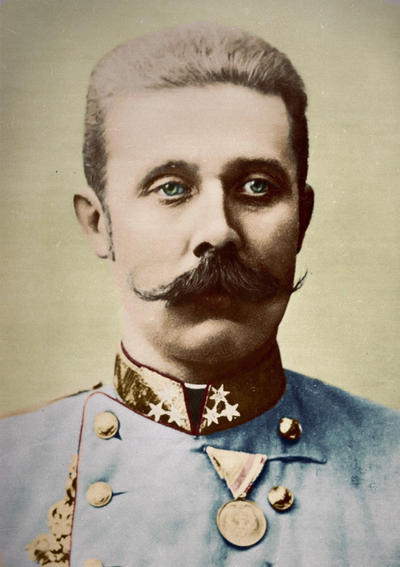
Archduke Franz Ferdinand
        Archduke Ferdinand and Emperor Josef didn't exactly get along. Ferdinand fell in love with Sophie Chetok von Chotkova, who the emperor saw as being below the archduke's station. In the end, Ferdinand was allowed to marry Chotkova under the condition that none of their children would have a right to the throne. Emperor Josef, still angry despite the compromise, didn't go to the wedding. The rift between the Archduke and the Emperor must have been quite large, because Emperor Josef didn't attend the Archduke's funeral either.

         Franz Ferdinand had a relatively enjoyable private life, with a loving wife and three well-behaved children. The Archduke's public life was a bit more stressful, as his ideas and goals were extremely unpopular with the other nobility and commoners. Namely, his main source of unpopularity was due to his belief that Slavs should have as much say in the government as Germans and Magyars. As one might imagine, the Germans and Magyars did not agree.

         In the last week of his life, June of 1914, Franz Ferdinand had been invited to Sarajevo, Bosnia, by General Oskar Potiorek. The Archduke was supposed to inspect military manuevers and have an overall diagnostic done on the army. On his arrival in Sarajevo and drive to the city hall, a hand grenade was thrown at his motorcade by a Black Hand member, who had been instructed to do so by a fellow member named Gavrilo Princep. Nobody was harmed and the assassin attempted to flee the scene. Knowing he would soon be caught, the assassin took a poison pill to silence himself. Well, the poison didn't work. Preferring to die for his Serbian cause, the assassin then jumped into a river to drown himself. The water ended up being too shallow to drown in, and authorities caught the would-be murderer before he could try something else.

        Understandably, Gavrilo Princep was feeling pretty bad about the way the assassination turned out; his henchman had been caught and the Black Hand was going to be exposed within days. So, while mulling over his eventual demise, Gavrilo went to a deli. By sheer coincidence, Archduke Franz Ferdinand's car broke down right in front of the deli that Gavrilo was eating in. Gavrilo, noticing this, promptly walked outside and shot the heir of the Austro-Hungarian empire. Outraged and noting that the Black Hand was a Serbian Nationalist group, Austria-Hungary declared war on Serbia. Following multiple alliance treaties, World War I had begun.

         So, by sheer coincidence, the Archduke was killed and World War I began. World War I would kill millions, and the resulting Treaty of Versailles set the stage for the rise of the Nazis, World War II, the Holocaust, and by extension, nearly every single problem in the Middle East since. Millions died, nations collapsed, and the world was changed forever because of one unlucky day in the life of an Archduke.

Source: Sources: http://www.firstworldwar.com/bio/ferdinand.htm
http://fc03.deviantart.net/fs71/i/2010/311/4/e/archduke_franz_ferdinand_by_kraljaleksandar-d32e09o.jpg