The year was 1920, referred to as the "Roaring 20s" for America. The flapper movement was gaining momentum, jazz was taking off, popular icons like Babe Ruth and Jack Dempsey were international celebrities, and radios were becoming a staple in evert family. World War I was over and the Great Depression wouldn't happen for another 9 years. The arts were flourishing, with the emergence of famous names like Ernest Hemingway and F. Scott Fitzgerald. Charlie Chaplin captivated audiences in the cinema, and America secured another record for itself when Charles Lindbergh made the first solo, nonstop flight across the Atlantic Ocean. On the surface, everything seemed perfectly jolly in the United States...except they weren't. Prohibition was in full swing and all America had to show for it was a higher crime rate, stronger criminal organizations, and more families going hungry so that mommy and daddy could get their fix of usually-toxic alcohol at a speakeasy. Incredible amounts of people had died in World War I, and the Bolshevik Revolution in Russia scared Americans and caused them to fear the increase in Eastern European immigrants. Soldiers coming home from World War I found their jobs occupied by blacks from the south, adding more fuel to the racist fire. Americans found themselves drifting towards Nativism, wanting the "true americans" (Read as: Northern Europeans) to have the best options in life. Racial and political tensions would come to center around a murder-robbery case involving two Italians, Nicola Sacco and Bartolomeo Vanzetti.
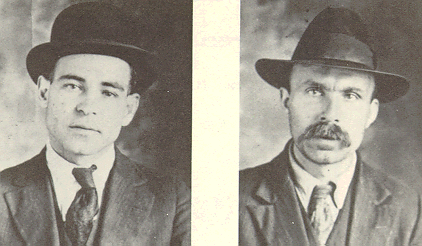 |
| Nicola Sacco (left) and Bartolomeo Vanzetti (right) |
Yet, the Italian anarchists wouldn't die for another 7 years, as the defense continually appealed the descision and there was just enough doubt over whether or not Sacco's gun had been the murder weapon. Ultimately, the original verdict was upheld and the two Italian anarchists were sent to the electric chair on August 23rd, 1927. In a court case with a non-biased jury and the forensics technology of the time, Sacco and Vanzetti would not have been convicted. Modern technology has shown that it was Sacco's gun used in the murder, but at the time there wasn't a way to know for sure. The modern opinion is that Sacco was indeed guilty, but Vanzetti was not. In a modern court, the given evidence would be still be considered inconclusive (though modern technology and techniques could have gathered more evidence towards making a solid verdict). Overall, the bias of the times lead to the deaths of two men, both of whom could have been innocent.
Source 1: http://www.history.com/this-day-in-history/the-sacco-vanzetti-case-draws-national-attention?catId=4
Source 2: http://www.writing.upenn.edu/~afilreis/88/sacvan.html
Source 3: http://writing.upenn.edu/~afilreis/Images/sacvanpics.gif
Source 2: http://www.writing.upenn.edu/~afilreis/88/sacvan.html
Source 3: http://writing.upenn.edu/~afilreis/Images/sacvanpics.gif

No comments:
Post a Comment